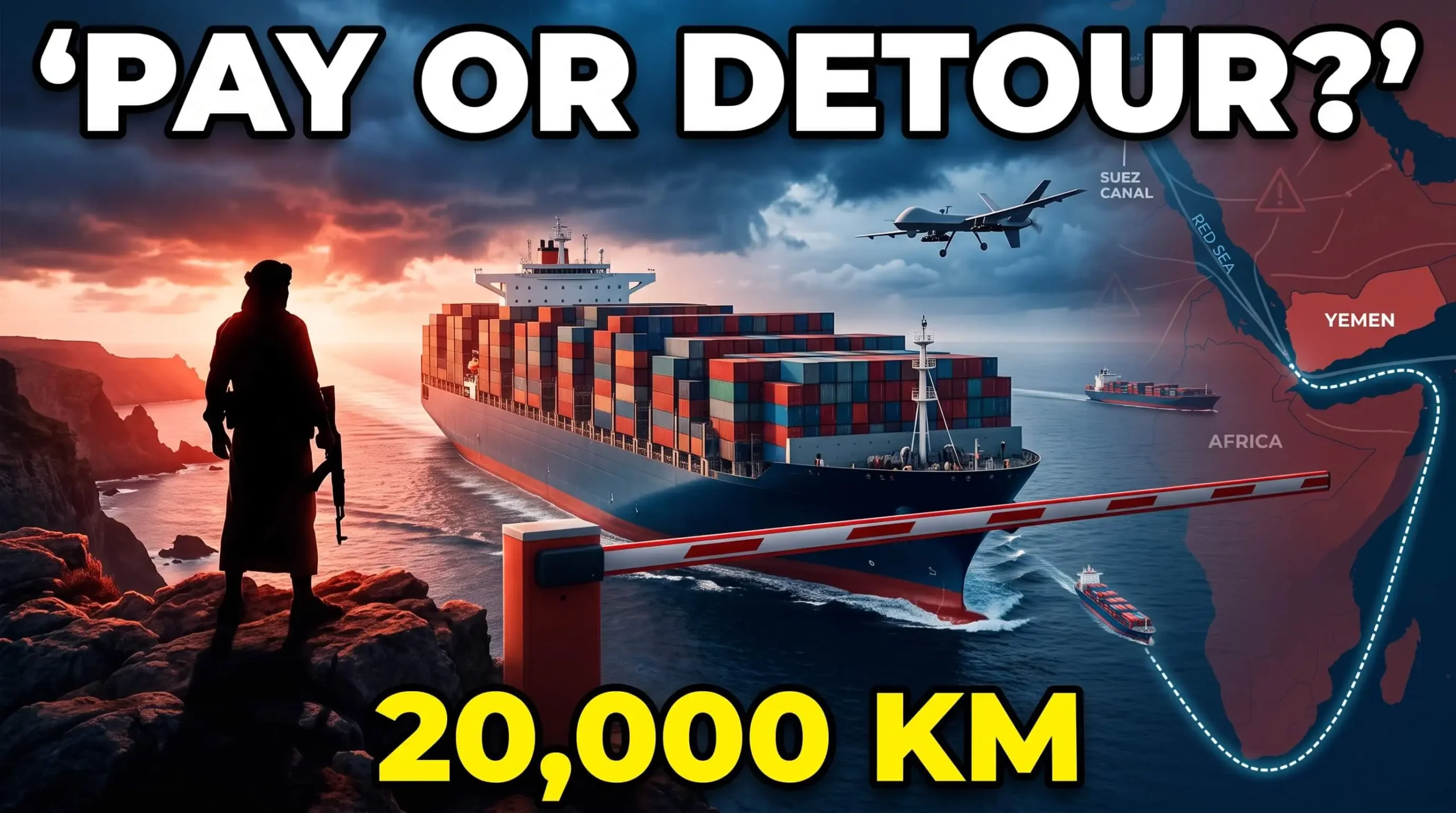

In geopolitics, power isn’t always about who has the biggest navy; sometimes, it’s simply about who controls the world’s most important chokepoints. Today, global shipping that sails through the Red Sea faces a brutal choice: pay a transit fee or take a much longer route around Africa.
The Red Sea is no longer a truly free transit route. The Houthis have shown that they can disrupt one of the world’s busiest shipping lanes by threatening to block the Bab-el-Mandeb Strait. According to an exclusive Reuters report, the Houthis now plan to charge ships a transit fee to pass through this narrow waterway. This comes after a week of declaring a naval blockade on Saudi Arabia and hitting a few Saudi-affiliated vessels.
If this policy is enforced, it would mark a major shift in global trade. The Bab-el-Mandeb Strait carries about 12% to 15% of global trade, making it one of the most important maritime chokepoints in the world.

How We Got Here
To understand how we got here, you have to look at the historical background of the situation. A decade ago, in 2015, Yemen was on the receiving end of a devastating, years-long naval and air blockade led by Saudi Arabia and its Western allies. Today, the Houthis have completely flipped the script.
Following the outbreak of the Israeli genocide in Gaza in November 2023, the Houthis closed the strait to Israeli and American interests, along with anyone supporting them.
Now, in 2026, Houthis describe the universal transit toll as payment for acting as the “net security provider” for vessels passing through this region. They also argue that they have long offered this service (free pass + security) without receiving any concessions in return. The group that was once under blockade is now in a position to shape how one of the world’s most important maritime chokepoints operates.
The $180 Million Toll
Apparently, if they will now start charging a fee from everyone (except China-will talk about it in a while), then this means this is no longer just about politics or war; instead, it has turned into a massive, highly profitable business. I am not arguing whether it’s fair or not, just stating a fact that now it’s no longer just about war.
But the surprising part is that this isn’t exactly a new operation. Since the blockade began in November 2023, they have reportedly been running a highly profitable, unofficial transit payment system, collecting millions of dollars behind the scenes. To avoid the massive detour around Africa, many European and Mediterranean cargo ships have reportedly been paying the Houthis quietly. Even I was astonished to read these reports.
Can you guess how much money we are talking about? Leaked reports suggest that during some months, the Houthis were earning up to $180 million (each month) from these unofficial transit payments.
You might wonder why some of the world’s biggest shipping companies would hand over millions of dollars to an armed group (which isn’t even an official state actor). I believe it simply comes down to math. Paying the Houthi toll is still much cheaper than paying for the extra fuel, time, and operating costs of sailing all the way around Africa. To these companies, paying the extortion fee is just a fraction of the cost they would lose otherwise.
A 20,000 KM Detour
Let’s look at the brutal logistics for those who refuse to pay the fee.
If a cargo ship traveling from Greece to Asia uses the Bab-el-Mandeb Strait, the journey to the Arabian Sea is roughly 5,900 to 6,000 kilometers.
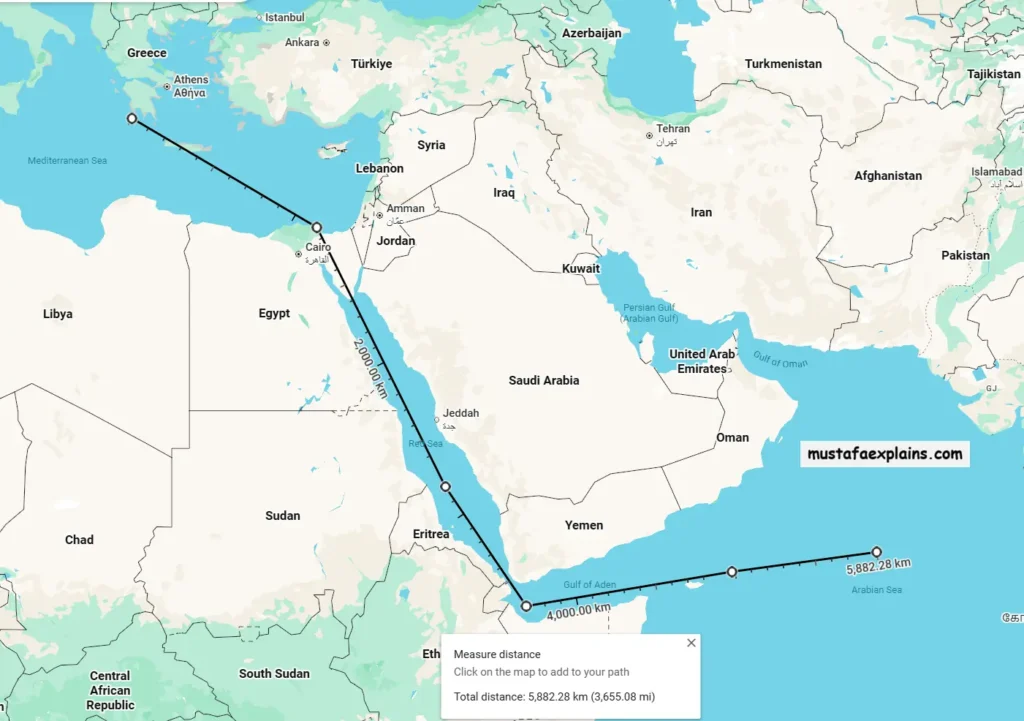
However, if the strait is closed to them or they refuse to pay the toll, they are forced to take a much longer route around the Cape of Good Hope in Africa. This detour increases the journey to over 20,000 kilometers. The extra 14,000+ kilometers means much higher fuel, energy, and crew costs while also adding weeks, and in some cases even months, to the voyage.
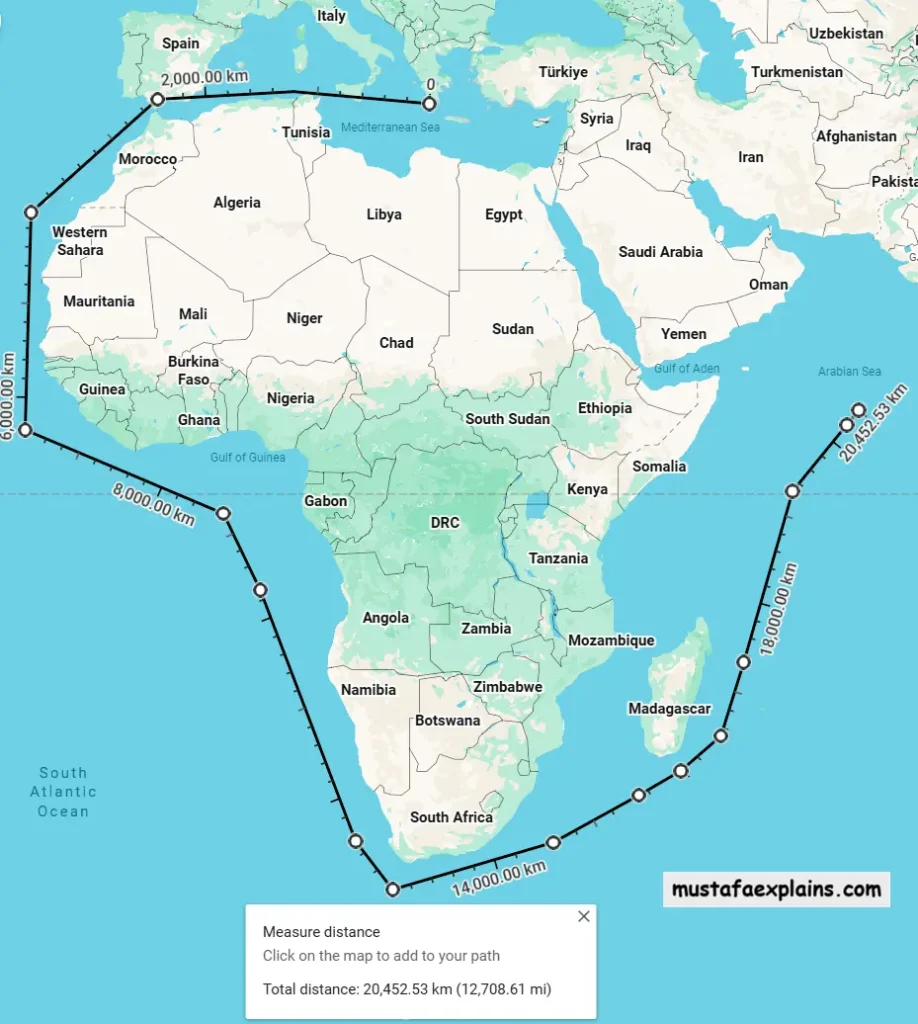
That is the math of asymmetric warfare. A few relatively cheap drones can impose billions of dollars in logistical costs on the global economy.
Detailed Cost Comparison of Both Routes
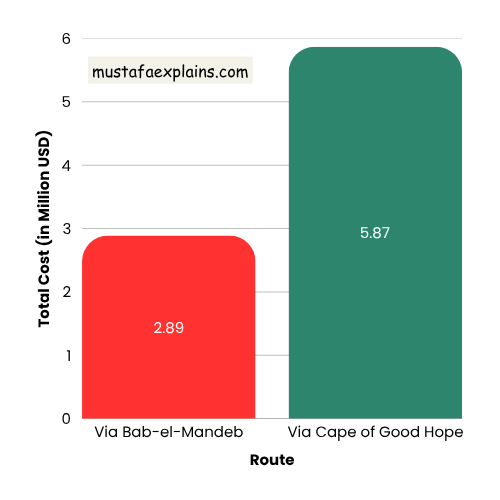
I have done detailed calculations and compared the shipping costs in both scenarios: whether a cargo ship uses Bab-el-Mandeb Strait or goes around the Cape of Good Hope in Africa.
These calculations might not be accurate, but I am confident that these are the closest estimates possible. I went through multiple industry reports, documents disclosed by shipping companies, and maritime research papers from 2024-2025. I’ve also added links to these sources.
Via Bab-el-Mandeb (Suez Canal Route)
- Fuel: $1.48 million (2,362 tons @ $625/ton)
- Operating Costs: $211,000 (crew, maintenance, management)
- Suez Canal Toll: $550,000
- War Risk Insurance: $400,000 (Red Sea/Houthi risk premium) [I haven’t included the Houthi extortion transit payments; that’s why including the insurance costs in case the ship tries to forcefully enter the Strait without paying the fee]
- Port Charges: $250,000
- Total: $2.89 million
Via Cape of Good Hope
- Fuel: $4.92 million (7,874 tons @ $625/ton)
- Operating Costs: $703,000 (extended voyage = more crew days, maintenance)
- Suez Canal Toll: $0 (avoided)
- War Risk Insurance: $0 (no high-risk zone)
- Port Charges: $250,000
- Total: $5.87 million
What This Means
The extra 14,000 kilometers adds:
- ~20 extra days at sea (nearly 3 weeks)
- $3.45 million in additional fuel costs alone
- $492,000 in extra operating costs (crew wages, provisions, maintenance)
- Total premium: ~$3 million per voyage
While ships save $550,000 in canal fees and $400,000 in war risk insurance (will be replaced with the Houthis’ transit fee) by avoiding the Red Sea, these savings are overshadowed by the $3.45 million in extra fuel costs and extended operational expenses.
Data Sources & Assumptions
- Vessel Type: 12,500-13,000 TEU container ship (typical Asia-Europe service)
- Fuel Price: $625/ton (VLSFO, 2024-2025 average)
- Fuel Consumption: 280 tons/day at 16 knotsman-es+2 (Source)
- Daily OPEX: $25,000 (crew $8k, insurance $3k, maintenance $5k, management $4k, other $5k) (Source)
- Suez Canal Toll: $550,000 (average for 13,000 TEU) (Source)
- War Risk Premium: $300,000-$500,000 for Red Sea transit (Source)
Key Industry References:
- OECD/ITF Red Sea Crisis report (2024): Cape route adds $1.7M per voyage for median container ships
- LSEG Shipping Research: Tanker diversion adds ~$933,000 per voyage
- DocShipper analysis: Cape route total cost premium $2-4M per voyage
- Multiple industry sources confirm 10-14 days additional transit time (Source)
Why China Got a Pass
It is important to note that every Western ship is caught in this brutal economic trap, except China.
The Houthis have explicitly stated that Chinese vessels will be granted “free passage” through the strait without paying any transit fees. To my knowledge, this exception is the result of a separate, undisclosed backdoor negotiation between Beijing and the Houthis that emerged after the November 2023 closures began. Since then, the Houthis have continued to revere that arrangement, allowing Chinese ships to pass through the route.
Therefore, while many Western shipping companies face higher costs by rerouting around Africa, Beijing has managed to keep its supply chains moving through its independent diplomacy.
The Risk of $200 Oil
When you zoom out, the main problem becomes even more serious.
As mentioned earlier, the Bab-el-Mandeb Strait facilitates about 12% to 15% of global trade. Meanwhile, the Strait of Hormuz handles around 20% to 25% of global energy trade. Together, these two chokepoints control over 30% of global energy trade and roughly one-third of overall global trade.
If both of these critical arteries were fully blocked or subjected to heavy transit fees, the resulting crisis could easily push global crude oil prices to $200 per barrel.
Moreover, the bigger geopolitical reality is that the world’s two most important maritime trade routes are now effectively falling under the direct control of Iran and Iranian-backed allied forces.
Traditional naval supremacy has failed to secure the seas, and the global economy is now entirely at the mercy of the gatekeepers.
Vocab
- transit: movement of people, goods, or objects from one place to another
- extortion: getting money or favors from someone by using threats, force, or fear
- detour: longer, less direct path used to avoid a blocked road
- revere: respect; honor
- artery: used as a metaphor to describe the strait as important as a blood vessel in the human body