
Every year on 14 August, Pakistan becomes a little different. Streets fill with green flags, children wear badges and shirts in national colours, patriotic songs play everywhere, and social media is full of messages about azadi (independence). It is a day of pride, and it should be.
Let me make one thing clear before going further: this is not another article asking, “Are we really independent?” Pakistan is an independent and sovereign country. We have our own state, institutions, constitution, foreign policy, armed forces, and national identity. Ask the people in places such as Palestine, Syria, or Libya (where occupation, conflict, or instability have shaped everyday life), and the value of a functioning independent state is not a small thing. Praise be to God, Pakistan has it.
But independence should not be treated only as a fact of history that we remember once a year. It should also be treated as a responsibility. A country becomes politically free when it can make its own decisions. But for ordinary citizens, especially young people, freedom should also mean something practical: the ability to study properly, find dignified work, learn useful skills, support one’s family, start something of one’s own, and plan life without feeling that the future depends only on connections, luck, or leaving the country.
As a student, I see this question around me all the time: capable young people work hard for grades and degrees, yet many remain unsure about what realistic opportunities will exist when their education ends.
That is the question this article explores. Not whether Pakistan is free as a nation, but whether Pakistan is creating enough economic freedom for its young people to use their talent and shape their own futures.
Political independence is not the same as economic freedom
Political independence and economic freedom are related, but they are not the same thing.
Political independence means that Pakistan governs itself. We have our own constitution, elected governments, courts, institutions, borders, foreign policy, and national decisions. Though this is debated, no outside power “directly” rules Pakistan. This freedom was the central achievement of 1947.
But economic freedom is more personal. It is about whether an ordinary person has a real chance to improve their life through education, work, skills, savings, or business. It means that a student who studies seriously should not feel that their future depends only on having relatives in the right places. It means that a young graduate should have more options than waiting endlessly for a government job, accepting unpaid work, or planning to leave the country because they cannot see a future at home.
For me, economic freedom does not simply mean low taxes or a completely unregulated market—the way the phrase is sometimes used in economic debates. It means having real choices. Can a young person get a quality education? Can they gain useful skills beyond a degree? Can they find dignified and productive work? Can they start a small business without getting lost in paperwork, informal payments, lack of access to finance, or worrying about extortion? Can they support their family and make long-term plans without one economic shock destroying everything?
More importantly, can they build business empires without worrying about someone murdering them the next day? (iykyk who i’m talking about)
This is where social and institutional freedom also matter. A student from a well-connected family in a major city often begins with better schools, reliable internet, English exposure, career guidance, and access to internships. Another student may have equal intelligence and work even harder, but may live in a district where these things are simply not available. In that case, the problem is not a lack of talent. It is an unequal starting point.
(nothing wrong in this though, it is obvious, and the same case for anywhere in the world: the larger the city, the better the opportunities)
The same applies to women. A young woman may be qualified and motivated, but whether she can study further or work may depend on safe transport, family support, workplace conditions, childcare responsibilities, or social attitudes. This is not only a social problem; it is an economic loss for Pakistan. When capable people cannot enter the economy or use their skills, the country loses productivity, income, innovation, and potential.
So, political freedom belongs to Pakistan as a nation. Economic freedom must be felt by Pakistanis as individuals. The real strength of independence is not only that a country can make its own decisions, but also that its citizens can build meaningful lives within it.
Also remember that political freedom gives a nation the right to choose its path; economic freedom gives an individual the ability to walk on it.
Pakistan’s youth: an opportunity or an opportunity gap?
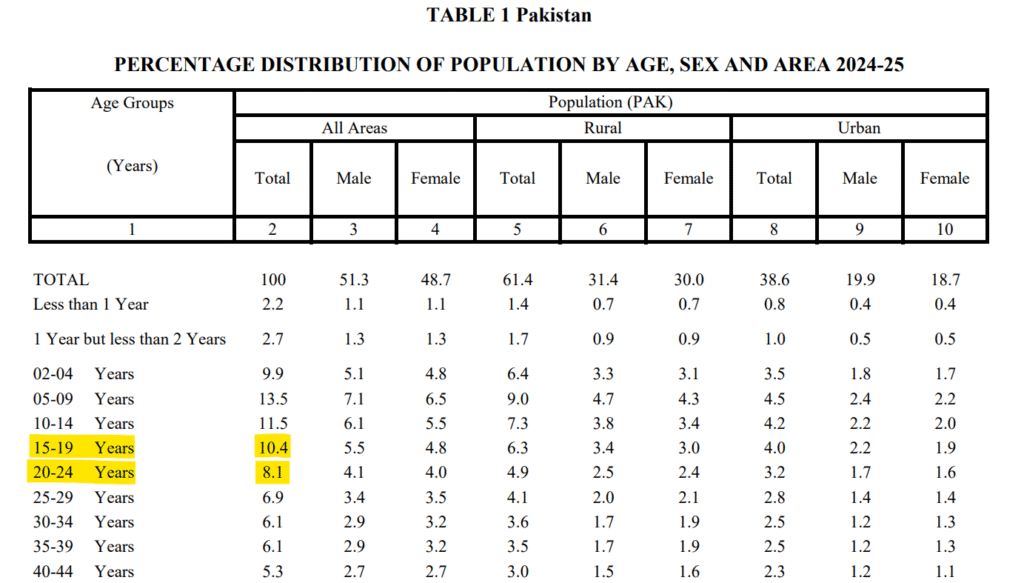
Pakistan is often described as a young country, and that is true. According to the latest Labour Force Survey, around 46.3 million Pakistanis were between the ages of 15 and 24 in early 2025 (about 18.5% of the total population). This should be one of Pakistan’s biggest strengths. A young population can bring new ideas, energy, workers, entrepreneurs, researchers, and consumers. It can increase productivity and help a country grow faster.
But a young population does not automatically become an economic advantage. It becomes an advantage only when young people are educated well, gain useful skills, and enter an economy that actually has space for them.
This is where we need to look beyond patriotic slogans. Many Pakistani students work hard for matric, intermediate, entry tests, university admissions, and degrees. Families spend a large part of their income on education because they believe education will create a better future. Yet after graduation, many young people discover that a degree alone does not guarantee a job, relevant experience, or even a clear direction.
The latest available Labour Force Survey-based figures show that overall unemployment in Pakistan was 6.9% in 2024–25. For young people, it was much higher: 12.5%. Young women faced an unemployment rate above 13%, while unemployment for urban women was reported at roughly 17–18%. These are not just numbers. Behind them are students applying repeatedly for entry-level jobs, graduates accepting work far below their qualifications, and young people delaying their plans because they cannot find a reliable way to earn.
Still, unemployment tells only part of the story.
A person is counted as unemployed only if they are actively looking for work and available to start. But what about someone who has stopped applying because every vacancy demands experience? What about a young woman who wants to work but lacks safe transport or family support? What about a graduate preparing for more exams because there are few worthwhile openings? What about someone doing irregular, low-paid work simply because there is no better option?
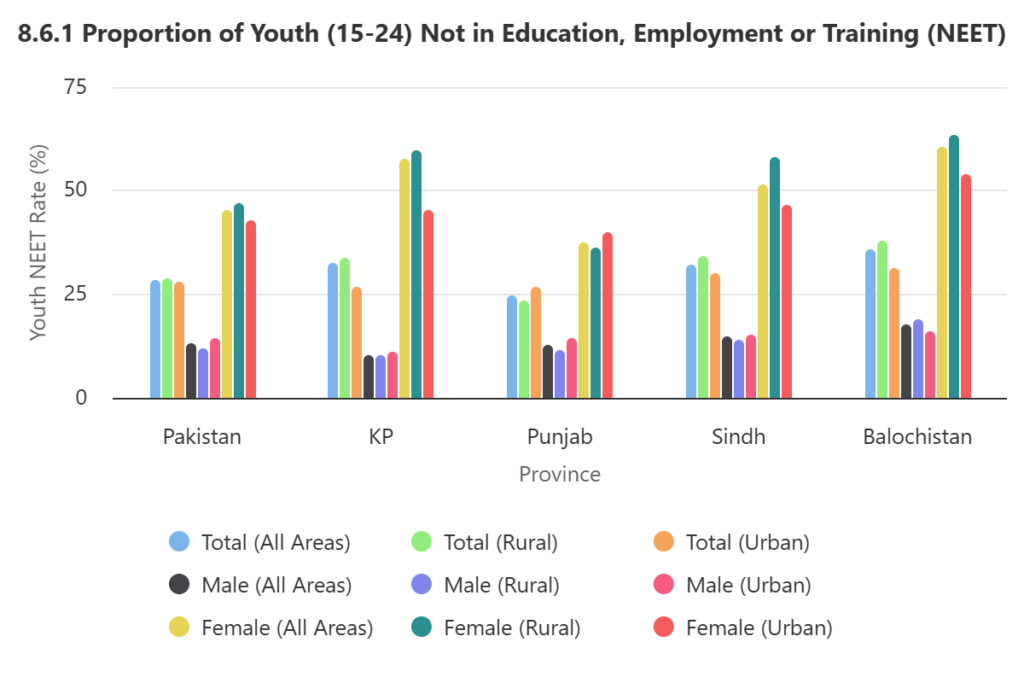
This is why the idea of NEET matters. NEET means young people who are not in education, employment, or training. Pakistan Bureau of Statistics uses this measure for people aged 15–24 because it shows a broader picture of young people who may be disconnected from both learning and work. In the 2020–21 Labour Force Survey, the youth NEET rate for ages 15–24 was 32.5%.

A separate analysis of those aged 15–29 found that 21.8 million young people (around 37% of that age group) were neither employed nor enrolled in education or training. The gap was especially serious for young women: 62% were classified as NEET, compared with 12% of young men.
However, NEET should not be treated as a perfect picture of youth opportunity. It measures whether a young person is formally counted as being in education, employment, or training. But in Pakistan, especially in rural areas, formal enrolment does not always mean regular attendance, effective teaching, or real learning. A student may appear in school records but doesn’t attend, mostly because of no monitoring.
Also, these figures should not be used to label an entire generation as lazy or unproductive. That would be unfair and inaccurate. The real issue is that many young Pakistanis are trying to enter adulthood through an economy where opportunities are uneven, formal jobs are limited, and personal networks often matter as much as ability.
A student in Karachi, Lahore, or Islamabad may have easier access to internships, professional events, LinkedIn networks, coaching centres, reliable internet, and people who can explain how a career actually works. A student in Sukkur, Larkana, Khairpur, Bahawalpur, Dera Ghazi Khan, or a smaller town may be just as talented, but may have to find these opportunities alone. Often, they do not know where to apply, whom to ask, what skills employers want, or how to get their first credible experience without moving to a major city.
That is why Pakistan’s youth issue is not simply a question of “creating jobs.” It is a question of creating pathways: pathways from school to skills, from skills to experience, and from experience to stable work. Without those pathways, a young population can feel less like a national advantage and more like a generation waiting at the entrance of an economy that has not made room for it.
Why a degree alone is not enough
For many families in Pakistan, education is seen as the main route to a better life. This belief is understandable. Parents spend years paying school fees, transport costs, academy charges, books, and university expenses because they hope a degree will give their children more stability than they had themselves.
And education does matter. It improves knowledge, confidence, communication, and long-term earning potential. But one of the difficult realities for young Pakistanis is that a degree by itself does not guarantee economic freedom.
A student may graduate with good marks and still struggle to find work because employers want experience. But how is a fresh graduate supposed to have experience if no one is willing to give them a first opportunity? This is one of the most common frustrations among young people: entry-level jobs often ask for one, two, or even three years of experience. Meanwhile, unpaid internships may be available only to those who can afford to work without income or already live near major employers.
The issue is not that Pakistani students lack talent. It is that education, skills, work experience, and employer demand often do not connect properly. A university may teach theory while employers expect practical ability: writing a professional email, using Excel, analysing data, presenting clearly, communicating with clients, researching a problem, or working in a team. These may sound like small things, but they often decide whether a young person can move from being “qualified” on paper to being useful in a workplace.
There is also a difference between having a job and having a job that provides stability, learning, and dignity. Pakistan has a very large informal economy. Informal work can include working without a written contract, predictable wages, social protection, or clear legal rights. It can be the shop worker paid daily, the delivery rider paid per order, the helper in a small workshop, the home-based worker, or someone doing freelance tasks without stable income.
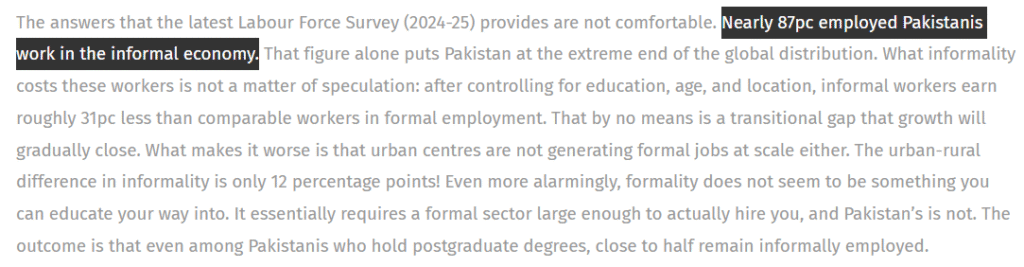
Recent analysis of the 2024–25 Labour Force Survey estimates that nearly 87% of employed Pakistanis work informally. It also finds that informal workers earn roughly 31% less than comparable formal workers after accounting for factors such as education, age, and location. This matters because unemployment statistics can create the impression that anyone counted as “employed” is economically secure. In reality, many people are working hard but remain vulnerable to a medical emergency, a slow business month, a flood, or the loss of a single client.
This is why the solution cannot be limited to telling students, “learn more skills.” Skills are necessary, but skills need an economy that can use them. If businesses are not expanding, investing, exporting, innovating, or hiring, then training programmes may simply produce more qualified young people competing for the same limited positions.
The World Bank’s assessment of Pakistan’s skills system makes a similar point: most jobs have been created in low-productivity activities, many workers are in informal employment, and labour-market policies should focus on job outcomes and career guidance—not merely the number of people trained.documents1.worldbank
There is another uncomfortable reality: access to skills is unequal. A student from a well-off household may get a laptop early, learn English, take online courses, attend events, and use family networks to find an internship. Another student may have the same ability but share one phone with siblings, face unreliable internet or electricity, lack mentors, and not know what opportunities even exist. The second student is not less capable; they simply have to spend much more effort reaching the same starting line.
That is why I do not think the discussion should be framed as “young people do not have skills” or “students are not working hard enough.” Pakistan has many hardworking and capable young people. The deeper problem is a weak bridge between learning and earning. Students need a pathway from school to useful skills, from useful skills to paid experience, and from paid experience to stable and productive work.
Economic freedom becomes meaningful when that pathway is available not only to the already privileged, but also to a capable student in Sukkur, Khairpur, Larkana, Bahawalpur, Turbat, or any other place far from the country’s main economic centres.
Freedom depends on more than markets
When people talk about economic freedom, they often focus only on jobs, salaries, businesses, or inflation. These things matter. But a person cannot benefit from a growing economy if they are blocked from entering it in the first place.
For a young Pakistani, economic opportunity is shaped not only by talent or hard work, but also by gender, ethnicity, location, family income, or access to networks. This is where the idea of freedom becomes more complicated, and more real.
Gender: a large part of Pakistan’s potential remains unused
Pakistan cannot claim to be using its full economic potential if a large number of capable women cannot study further, enter paid work, or remain in work after marriage and children.
The latest Labour Force Survey-based figures show a wide gap between men and women. About 81.4% of men aged 15 and above are in the labour force, compared with only 27.8% of women. The employment rate is 76.3% for men and 24.5% for women. Women who do enter the labour force also face higher unemployment: 11.7%, compared with 6.3% for men.
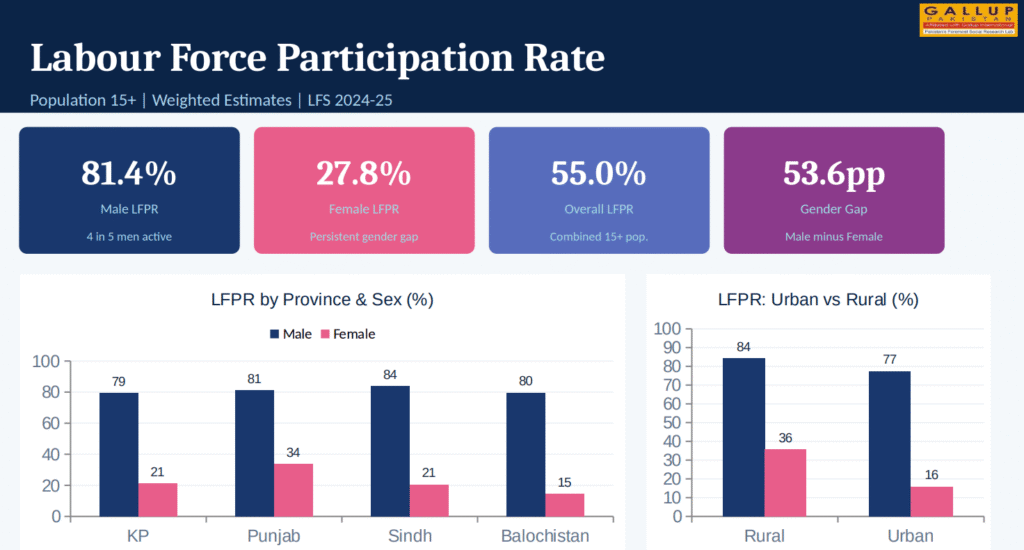
These figures should not be used to judge women who choose unpaid care work at home. Caring for children, parents, and households is real work, even when it is not counted in GDP or labour statistics. The issue is whether women who want to study, work, build a career, or start a business have a fair chance to do so.
For many women, the barrier is not a lack of ability. It can be unsafe or expensive transport, the absence of childcare, restrictive workplace conditions, family concerns about mobility, harassment, or the belief that certain careers are not appropriate for women. Research on Pakistan has identified these practical constraints (mobility, care responsibilities, skills and networks, hiring discrimination, and restrictive norms) as barriers that reinforce one another.
Worth reading: How Female-Friendly Are Workplaces in Urban Pakistan?
This is not only a question of social justice. It is also an economic question. When a qualified woman cannot work because there is no safe way to reach an office, no childcare support, or no acceptable workplace nearby, Pakistan loses skills, household income, tax revenue, innovation, and productivity.
Geography: talent is national, opportunity is not
Pakistan has talented students in every province and district. But opportunities are not equally distributed.
A student in Karachi, Lahore, or Islamabad may have access to universities, career events, professional networks, internships, libraries, reliable internet, and employers who are willing to hire fresh graduates. In a smaller city or rural district, the same student may have to travel far for a university, depend on weak internet, or have no direct contact with people working in their intended field.
This creates a hidden cost of birthplace. It is not enough to say that a student is “free to apply” if applying requires money for travel, a relative in a major city, access to information, or the ability to accept an unpaid internship. Pakistan should not become a country where young people must leave their home region merely to access their first serious opportunity.
There is an important distinction here: people should always be free to move for education or work. Migration can broaden horizons and bring income to families. But it should be a choice, not the only route available to a capable person.
Institutions: merit must matter more than connections
The final part of economic freedom is institutional freedom: whether rules are predictable, information is available, and opportunities are based on merit.
Many young Pakistanis know the phrase “reference lagwa lo” [get someone to recommend me]. Networking is normal in every country, and knowing people can help someone learn about an opportunity. The problem starts when a reference becomes more important than competence, or when recruitment is unclear enough that applicants believe only connections can get them through.
This is damaging beyond the individual case. When young people think merit will not be rewarded, they invest less in developing skills and more in finding influence. Employers may recruit weaker candidates. Capable people become discouraged or migrate. Over time, trust in institutions falls.
A fair system will not remove every inequality overnight. But it can make the path clearer: transparent internships, publicly advertised vacancies, standardised recruitment, timely results, clear criteria, and accountability when rules are ignored. These are not small administrative reforms. They are part of what makes economic freedom real.
What would economic freedom actually require?
It is easy to say that Pakistan needs jobs, better education, and more opportunities. The harder question is: what would that look like in practice?
There is no single scheme that can solve a problem this large. A laptop distribution program, a short skills course, a government job announcement, or a loan scheme may help some people, but none of them alone can create economic freedom for millions of young Pakistanis.
What Pakistan needs is a connected system: children who actually learn, students who gain useful skills, young people who can access their first work experience, and an economy that creates enough productive jobs for them to grow in.
1) Focus on learning, not only enrollment
The first step begins long before university or the first job interview. It begins in school.
Pakistan should stop treating school enrollment as the final measure of educational progress. A child whose name appears in a school register but who does not attend regularly, has no teacher in class, or cannot understand what they read is not receiving the education needed for economic freedom.
The real goal should be simple: children should attend school, learn basic reading and mathematics, develop confidence, and leave school with the ability to keep learning. The World Bank’s Human Capital Review makes a similar argument: Pakistan needs a long-term approach that builds capabilities from early childhood through schooling and ultimately into productive employment.
This also requires better monitoring. District-level data should not only show how many children are enrolled; it should show attendance, learning outcomes, teacher availability, school facilities, and whether students (especially girls) can reach school safely.
2) Build a bridge between education and work
Pakistan has an education system and a labour market, but the bridge between them is often weak.
Students need more than degrees. They need paid internships, apprenticeships, career counselling, workplace exposure, and guidance on what different industries actually require. A student should not reach their final semester and only then discover that employers expect Excel, communication, data analysis, English writing, portfolios, or prior experience.
This is where universities, colleges, technical institutes, businesses, and local governments need to work together. Employers should help shape courses and offer supervised placements. Universities should be judged not only by admissions or graduation numbers, but also by how well they prepare students for work, research, enterprise, and further education.
The World Bank’s skills assessment for Pakistan makes an important recommendation: measure success through labour-market outcomes (job placement, career guidance, and whether training leads to better work) not merely through the number of certificates issued.
3) Create demand for skilled workers
Pakistan cannot train its way out of youth unemployment if the economy does not create enough good jobs.
This is the part that is often ignored. When young people cannot find work, we usually tell them to learn coding, start freelancing, open a small business, or “become entrepreneurs.” These can be valuable options. But not every student can become a freelancer or business owner, and no country develops by expecting every unemployed graduate to create their own job.
Pakistan needs firms that are growing, exporting, adopting technology, and hiring people with increasing levels of skill. This means linking education policy with industrial, trade, investment, and technology policy. Productive opportunities can come from export-oriented manufacturing, IT-enabled services, agricultural processing, logistics, renewable energy, tourism, and small businesses that are able to formalise and expand.
The key question should not only be, “How many people were trained?” It should be, “What kind of work did they enter afterward, how much did they earn, and did that work make them more productive over time?”
4) Make women’s work possible in practice
If Pakistan wants economic freedom for its youth, it cannot treat women’s participation as a secondary issue.
Many young women do not need motivational speeches; they need practical support. Safe and affordable transport, workplace safety, childcare options, flexible work arrangements where appropriate, access to finance, reliable internet, and fair recruitment can make the difference between a qualification sitting unused and a woman building an independent career.
Pakistan recently launched its first National Youth Employment Policy, which reportedly includes a 35% quota for women in the labour force and a 10% annual quota for youth-led start-ups. These announcements can be a useful starting point, but quotas and policies should be judged by implementation: who gets access, in which districts, what jobs are created, whether positions are safe and decent, and whether women are able to remain in work over time.
A policy is only meaningful when it reaches the student in a small city, the young mother who needs childcare, and the qualified graduate who cannot accept a job because reaching the workplace is unsafe or unaffordable.
5) Take opportunity beyond three major cities
Finally, economic freedom cannot remain concentrated in Karachi, Lahore, and Islamabad.
Pakistan needs regional opportunity: strong public universities, reliable digital infrastructure, local career centres, business incubators, industry partnerships, and better transport in secondary cities and districts. A student in Sukkur, Khairpur, Larkana, Bahawalpur, or Turbat should not have to depend entirely on relocation, relatives, or luck to begin a serious career.
Remote work can help, but it is not a complete answer. It still requires good internet, electricity, devices, English and digital skills, payment systems, and access to international or national clients. The goal should be to develop local economic ecosystems as well: businesses that hire locally, universities that connect to employers, and value chains that allow regional industries to grow.
Economic freedom will not come from one announcement on 14 August. It will come when Pakistan begins to measure success differently: not by how many schemes it launches, but by whether a young person (regardless of gender, family background, or city) can realistically turn education and effort into a stable future.
Conclusion
Pakistan’s independence is not in doubt. It was achieved through sacrifice, political struggle, and the belief that a people should have the right to decide their own future. On 14 August, that achievement deserves to be remembered with pride and gratitude.
But political independence is not the end of the national journey. It is the foundation on which everything else must be built.
For Pakistan’s young people, azadi should also mean having a fair chance to build a life with dignity. It should mean that a student’s future is not decided mainly by their family connections, gender, city of birth, or ability to move to Karachi, Lahore, or Islamabad. It should mean that education leads to learning, learning leads to useful skills, skills lead to opportunity, and hard work has a realistic chance of being rewarded.
This does not mean every young person will get their dream job. No country can promise that. But a serious country should ensure that effort is not wasted, talent is not ignored, and millions of young people are not left waiting outside the economy.
Pakistan has no shortage of ambitious students, capable women, hardworking families, and young people willing to learn. The bigger question is whether our institutions, schools, universities, businesses, and policies can give that potential a real path forward.
The deepest tribute we can pay to Pakistan’s independence is not blind optimism, and it is not constant despair. It is the patient work of building a country where more people can stand on their own feet, through merit, skills, enterprise, and fair opportunity.
That is not a rejection of azadi [independence]; instead, it is its next meaning.